Triumph Over Depression with Tony Soprano: A Mental Health Warrior Deli Moment

Updated: May 19

Last weekend, I decided to try a new deli in town — craving a good sandwich and a break from the daily grind. The moment I stepped inside, the aroma of freshly baked bread and stacked pastrami hit me.
But that wasn’t the most surprising part of my day.
In the corner, absolutely demolishing a massive sandwich, sat Tony Soprano — the larger-than-life figure from The Sopranos.
Now, I’m not one to get starstruck — especially not by someone with Tony’s… business background. Still, seeing him there was enough to make me pause. I wasn’t about to interrupt his meal, particularly with a couple of intimidating “associates” nearby.
So I grabbed my sandwich and sat down.
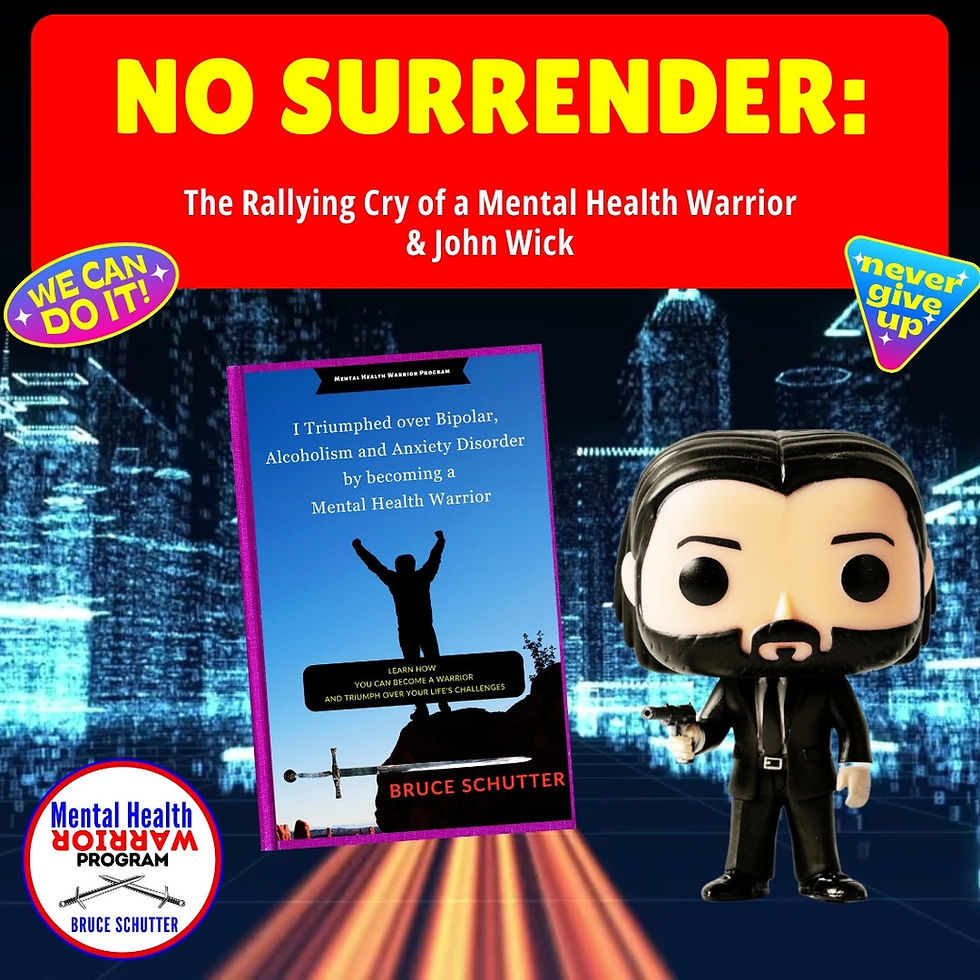
That’s when Tony noticed the book on the table next to me: I Triumphed over Bipolar, Alcoholism, and Anxiety Disorders by Becoming a Mental Health Warrior.
He glanced at it, then at me. “That looks interesting,” he said.
And in that moment, I realized something surprising — Tony was open to talking about mental health. Which, when you think about it, made perfect sense given everything he struggled with throughout the series.
Just like that, the conversation began.
The Warrior Story
As we started chatting, I opened up about one of my biggest struggles with Bipolar Disorder: the crushing weight of Depression.
"When it hits, it feels like there’s no way out," I said. "Every day becomes tougher than the last!"
Tony nodded, clearly resonating with my words. He had faced his own share of struggles. “So, what works for you?” he asked, genuinely curious.
I took a deep breath and told him my story — for 20 years I struggled with Bipolar, Alcoholism, Anxiety Disorders and PTSD. It left me feeling so powerless, that I tried to end my life. But in that dark time, I discovered something life-changing: mental health is the key to overcoming any challenge in life.
Armed with that knowledge, I created the Mental Health Warrior Program — bold new SELF-HELP approach that puts YOU in charge!
So you can take charge of your emotions, triumph over challenges each day, like Depression and build the life you really want!
Power of Warrior Principle 6
In my book, I Triumphed over Bipolar, Alcoholism, and Anxiety Disorders by Becoming a Mental Health Warrior, I don’t just share my story — I lay out the blueprint for becoming a Warrior, along with practical tools you can start using today.
One core part of that blueprint is the 15 Warrior Principles. They aren’t rules or rigid instructions. They’re guides — built to inspire action and strengthen you when challenges hit.
I leaned in and shared one of the most powerful strategies from the program with Tony:
Warrior Principle 6: Talking about your emotions is one of the most powerful and effective weapons for strengthening your mental health.
This principle is especially powerful when it comes to combating depression — and honestly, just about any mental health challenge.
Tony’s interest immediately sharpened. So I broke it down for him, sharing three key lessons on how I use this principle in my own life.
Lesson 1: Talking Breaks the Cycle
“First,” I said, “talking to family or friends about what you’re going through is crucial.
When I’m in the depths of depression, just saying my thoughts out loud helps me start moving again. If I don’t, those thoughts stay locked inside — festering, looping and pulling me deeper into despair.”
I paused, then added, “But when I share them, they lose much of their power. Once they’re out in the open, I realize two things: I’m not alone — and this feeling isn’t unbeatable.”
And that realization is powerful!
Your Turn:
Open up about how you’re feeling. Talk to a trusted friend, a family member — even your pet if that’s where you feel safest. Saying your emotions out loud is the first step toward action.
When emotions stay bottled up, they fuel the cycle of depression. But when you speak them, you create distance from them — and that distance creates clarity.
Talking doesn’t solve everything at once. But it loosens the grip, restores perspective and reminds you that you don’t have to fight alone.
As the saying goes, what stays hidden in the shadows grows stronger. Shine a light on your emotions — and you take the first step back into charge.
Lesson 2: Action Restores Control
Tony listened carefully as I explained, “This principle reminds me that I still have power — even when depression shows up.
It’s easy to feel completely powerless in those moments. But when I use Warrior tools like mindfulness, movement and talking things out, I can interrupt depression’s grip and take back control of my day.”
Tony’s eyes lit up at the word control. “I like being in control,” he said with a smirk. “And this talking thing — still new to me — turns out to be a pretty powerful way to get it back.”
“Exactly,” I replied. “When depression starts creeping in, that’s your cue to push back. Not by knocking it out in one punch — but by outmaneuvering it.”
I smiled. “Think of it like chess… or, in your case, running a strategic operation.” Tony chuckled. “So I just gotta outsmart it? Like keeping the feds off my back?”
“Pretty much,” I said. “Depression wants to be the boss — but you don’t have to let it call the shots.”
Your Turn:
When depression feels overwhelming, remind yourself that you still have Warrior tools at your disposal. You don’t need a massive breakthrough — just one small action.
That might look like:
Going for a short walk
Practicing mindfulness for a few minutes
Talking through what you’re feeling instead of shutting down
Small actions create momentum. Momentum restores control.
And if you need a smile to break the heaviness, ask yourself: “What would Tony Soprano do?” (You know… minus the whacking people part.)
Lesson 3: Your Challenges Don’t Define You
Finally, I shared the third way to apply Warrior Principle 6: understanding that having challenges doesn’t mean you’ve done anything wrong.
“It’s easy to feel like a failure when you’re struggling with something like Bipolar Disorder,” I said. “But this isn’t about failure — it’s about managing the cards you’ve been dealt.
Depression isn’t a sign of weakness. It’s part of the journey. And with the right Warrior tools, you stay in charge — not your challenges.”
Tony took a moment, then nodded. “I’ve been there,” he said quietly. “And you’re right. Knowing you still have power — that changes everything.”
“Exactly,” I replied. “Today, my mental health challenges are part of my story — but they don’t define me. I own them. I manage them. And I keep moving forward.”
Your Turn:
Depression is not a measure of your worth or your ability. It’s a challenge — not a verdict.
Think of it like driving. You can’t control the other drivers. Some will cut you off. Some will camp out in the fast lane going ten miles under the speed limit (seriously… why?).
But you can control how you respond.
You control the music. The temperature. The snacks. And — with practice — maybe even the road rage.
Real control comes from focusing on what you can control. And trust me, that’s a lot more power than most people realize!
Wrap Up
As we wrapped up our conversation, Tony surprised me by covering my entire lunch bill. I wasn’t about to argue with the guy, so I graciously accepted.
But the real surprise came when Tony turned to his crew and said, “Listen up, fellas. We could all use this Warrior advice. It’s time to start talking about our emotions.”
Who would’ve thought? Tony Soprano — ruler of North Jersey — championing emotional honesty. That was the real win of the day.
As I left the deli, I felt something deeper than satisfaction (though a free lunch never hurts). I’d seen firsthand how talking about emotions can bridge even the widest gaps and remind us we’re not alone in our struggles.
That’s the heart of Warrior Principle 6: Talking about your emotions is one of the most powerful and effective ways to strengthen your mental health.
Before heading out, I slid a copy of my book, I Triumphed Over Bipolar, Alcoholism, and Anxiety Disorder by Becoming a Mental Health Warrior, across the table so Tony could dive deeper into the program himself.
So the next time you feel weighed down by bipolar depression — or any depression — remember this: You and Tony Soprano are Mental Health Warriors.
No matter what life throws your way, you have the power to push through — not by pretending everything is fine, but by opening up, having real conversations and recognizing that you are NOT broken!
Bruce Schutter ⚔️
Every day is a chance to choose strength — because YOU'RE IN CHARGE!